Powder Enzyme Cleanser vs Foaming Gel and Scrubs: How Enzymatic Exfoliation Works for Sensitive, Oily Skin
Discover how water-activated powder enzyme cleansers dissolve dead surface keratin without friction, how they compare to foaming gels and physical scrubs, and how to safely use them for oily, acne-prone skin.
Key takeaways
- Proteolytic Keratolysis: Water-activated powder enzyme cleansers use hydrolytic enzymes, such as papain, to digest the protein bonds holding dead surface corneocytes together, exfoliating skin without the mechanical friction of abrasive beads.
- Mechanistic Differences: Traditional foaming and gel cleansers rely on surfactant micelles to lift sebum and dirt, while physical scrubs use manual abrasion to dislodge dead cells. Enzymatic powders combine mild surfactant cleansing with biochemical desquamation.
- Acne and Friction Risks: According to clinical research, vigorous manual scrubbing can aggravate acne lesions and irritate reactive skin, making non-abrasive chemical or enzymatic approaches preferable for sensitive, blemish-prone profiles.
- Barrier Considerations: Proteolytic enzymes are potent; research indicates active papain can alter tight-junction proteins and increase transepidermal water loss if overused. Formulas buffered with soothing humectants help maintain moisture balance.
- Customizable Use: Powder formulas allow users to modulate cleansing intensity by adjusting water dilution. Skincare guidelines suggest beginning with two to three applications per week before considering daily integration.
Enzymatic action explained
The outermost layer of human skin, the stratum corneum, consists of flattened, keratin-rich cells called corneocytes bound together by specialized protein structures known as corneodesmosomes. In healthy skin, natural enzymes continuously degrade these protein linkages in a process called desquamation. However, excess sebum production, humid climates, or sluggish cell turnover can cause dead corneocytes to accumulate, leading to congested pores, dullness, and uneven texture.
Enzymatic exfoliation replicates and assists this natural shedding process. As detailed in the Journal of Investigative Dermatology, topical hydrolytic enzymes facilitate the shedding of surface corneocytes by breaking down the intercellular protein bonds that hold dead cells to the skin. Plant-derived proteases, such as papain (extracted from papaya), specifically target and hydrolyze keratin proteins on the skin surface. As noted in the Kiero Glass Skin Guide, this enzymatic action dissolves protein buildup directly rather than relying on abrasive particles to dislodge it manually.
| Format | Primary Mechanism of Action |
|---|---|
| Powder Enzyme Cleansers | Proteolytic digestion of keratin bonds (hydrolytic desquamation) |
| Physical Facial Scrubs | Manual friction and particulate abrasion across the stratum corneum |
| Foaming and Gel Cleansers | Surfactant micelle emulsification and solubilization of surface sebum |
In dry powder cleansers, enzymes remain stable and dormant until they come into contact with moisture. According to review findings published on omgbart.com, these enzymes activate upon mixing with water, with their catalytic activity tapering off within one to two minutes after lathering. This brief window of peak activity allows the cleanser to loosen debris and refine surface texture during a normal wash cycle without requiring extended contact time on the skin.
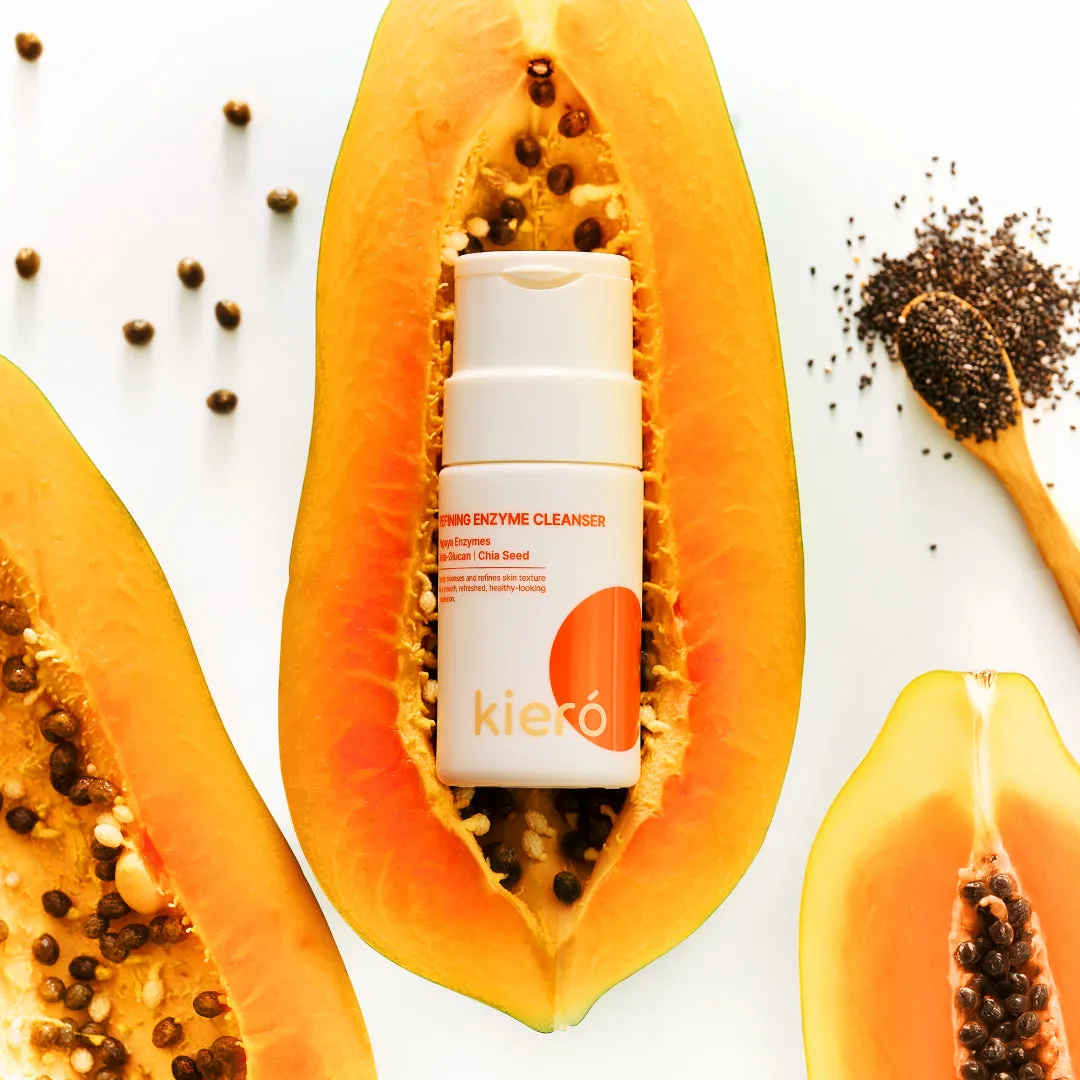
Refining Enzyme Cleanser
Powder enzyme cleansers vs foaming gels and scrubs
Choosing between a powder enzyme cleanser, a surfactant gel, and a physical scrub depends on how each formulation interacts with surface sebum, skin lipids, and active blemishes.
| Category | Exfoliation Method | Surfactant & Base | Sensitivity Profile |
|---|---|---|---|
| Powder Enzyme Cleansers | Proteolytic hydrolysis of keratin protein bonds | Water-activated dry powder to foam | Low mechanical friction; frequency-dependent |
| Foaming & Gel Cleansers | Minimal (unless formulated with secondary acids) | Liquid surfactant micelle solutions | Variable; risk of lipid disorder if over-cleansed |
| Physical Facial Scrubs | Mechanical abrasion via granular particles | Emulsion or gel base with abrasive grit | High friction; risk of irritation and acne flare |
Powder enzyme cleansers vs physical scrubs
Physical facial scrubs rely on manual pressure to move abrasive particles, such as ground seeds, cellulose, or mineral beads, across the skin surface. As explained by Beauty Society, physical exfoliants use a grainy texture applied by massage to dislodge surface build-up. While Kiehl's notes that physical exfoliants can deliver near-instant smoothing results, aggressive mechanical pressure carries notable risks.
The American Academy of Dermatology warns that harsh scrubbing can irritate sensitive skin, recommending gentle, non-abrasive cleansing over mechanical friction. Furthermore, a clinical review in PMC3088928 highlights that vigorous scrubbing can aggravate active acne lesions rather than reducing oiliness. Powder enzyme cleansers offer an alternative by substituting physical friction with biochemical protein breakdown, loosening surface congestion without abrasive rubbing.
Powder enzyme cleansers vs foaming and gel cleansers
Standard foaming and gel cleansers are designed primarily to lift surface oil, sweat, and environmental impurities using surfactants. As detailed in PMC3425021, surfactant molecules organize into micelles that solubilize non-polar lipids, allowing them to rinse away with water. However, surfactant exposure can also solubilize intercellular stratum corneum lipids, potentially disordering the lipid bilayer and weakening barrier function if formulations are overly aggressive or used excessively.
While gel cleansers primarily target sebum rather than keratin bonds, powder enzyme cleansers perform dual functions: they generate a light lather to capture oil while active proteases loosen dead skin cells. However, dry powders are not universally surfactant-free; they incorporate solid surfactants (such as sodium cocoyl isethionate or sodium methyl cocoyl taurate) that generate foam when hydrated.
Papaya enzymes and sensitive, acne-prone skin
Papain, an enzyme derived from the fruit of Carica papaya, is widely incorporated into water-activated cleansers because it hydrolyzes large protein molecules into smaller peptides. Editorial research on omgbart.com notes that protease enzymes can serve as a substitute for traditional direct acids (such as glycolic or salicylic acid) for sensitive-leaning skin types seeking non-abrasive texture refinement.
However, enzymatic exfoliation should not be assumed to be entirely inert or barrier-neutral. A study published in PMC4471117 demonstrated that active papain possesses substantial biological potency. In experimental models, topically applied active papain increased transepidermal water loss (TEWL) within 30 to 60 minutes, indicating a temporary disruption of epidermal barrier integrity. The study also observed that papain degraded tight-junction proteins, including ZO-1, claudin-4, and occludin, in cultured human keratinocytes at concentrations as low as 1 μg/ml, and triggered vascular permeability in animal models.
| Mechanism / Aspect | Detail |
|---|---|
| Biochemical Mechanism | Enzymatic cleavage of stratum corneum keratin bonds |
| Potential Barrier Risks | Increased TEWL and tight-junction protein disruption if overused |
| Formulation Countermeasures | Addition of humectants and barrier soothers (beta-glucan, chia seed) |
| Safe Application Approach | Water activation, short contact time, phased weekly introduction |
Double cleansing with balms and enzyme powders
Double cleansing involves using an oil-based cleanser followed by a water-based wash to ensure the thorough removal of makeup, mineral sunscreens, sebum, and environmental debris.
As outlined in the Kiero Reference Guide, water-activated powder enzyme cleansers are not engineered to dissolve heavy silicones, waterproof sunscreen filters, or long-wear foundation on their own. In warm, humid climates where high-adhesion sunscreens and excess sweat are common, starting with an oil or balm, such as Kiero's Comfort Cleansing Balm ($11.99), breaks down lipid-soluble coatings without requiring aggressive scrubbing with a washcloth.
Following an oil balm with a powder enzyme cleanser allows the second step to wash away residual emulsifiers while gently refining the skin surface. However, users must be mindful of overall barrier tolerability. According to a clinical survey published in Cosmoderma, dermatologists widely endorse gentle exfoliation for acne-prone skin, but caution against active exfoliants for individuals experiencing active dermatitis or a severely compromised epidermal barrier. If the skin is stinging, sensitized, or actively peeling, alternating the enzyme wash with a simple, non-exfoliating surfactant rinse prevents cumulative barrier stress.
Application technique and frequency guidelines
Because powder enzyme cleansers are water-activated, the physical lather and the concentration of the active wash can be adjusted during application.
- Dispense: Pour a dime-sized amount into wet palms
- Emulsify: Add lukewarm water and rub palms to create a rich, creamy lather
- Apply: Massage gently onto damp face using light circular motions (no scrubbing)
- Contact Time: Limit active contact to 30–60 seconds to avoid barrier degradation
- Rinse & Follow: Rinse thoroughly with lukewarm water; apply moisturizer to seal hydration
Dilution and lather modulation
According to the usage guide on Papa Recipe, powder formulas allow users to adjust the intensity of the cleanse by modulating the amount of water added to the palm. Adding a few drops of water generates a denser, concentrated micro-foam, whereas adding more water produces a light, airy lather with a more diluted surfactant and enzyme profile. The powder should always be fully lathered in the hands before touching the face to ensure even distribution and prevent un-dissolved granules from rubbing against the skin.
Frequency and schedule recommendations
- Initial Introduction: For oily, acne-prone, or sensitive skin, guidance from Papa Recipe and the Kiero Reference Guide recommends beginning with two to three evening applications per week. This allows the skin barrier to acclimate to proteolytic activity.
- Maintenance for Sensitive Profiles: Sensitive or easily flushed skin should generally maintain a schedule of two to three uses per week rather than daily application.
- Daily Adjustment for Oily Skin: If well-tolerated, frequency may be increased to once daily, ideally in the evening. In the morning, cleansing should be adapted to skin condition: as noted in the Kiero Routine Guide, oily skin can be cleansed lightly, while balanced skin may only require a lukewarm water rinse.
- Limiting Over-Cleansing: Dermatological advice from Skin Type Solutions suggests that once-daily surfactant cleansing is often sufficient for combination skin to prevent lipid stripping, while Rodan + Fields recommends limiting facial cleansing to twice daily at most.
FAQS
Frequently asked questions
Can a powder enzyme cleanser replace my regular daily foaming gel?
Yes, a powder enzyme cleanser can serve as your primary water-based cleanser, provided your skin tolerates daily enzymatic exfoliation. However, for sensitive or combination skin, many users prefer alternating: using a standard gentle gel cleanser on most days and substituting the powder enzyme wash two to three evenings per week to manage dead cell buildup without over-taxing the stratum corneum.
How is an enzyme cleanser gentler than a facial scrub for oily, acne-prone skin?
Physical facial scrubs rely on abrasive grit that mechanically scratches across the skin. Clinical findings published in PMC3088928 show that vigorous scrubbing can aggravate acne lesions and cause barrier irritation. Powder enzyme cleansers break down the protein bonds between dead skin cells biochemically, eliminating the mechanical friction associated with particulate scrubs.
Can papaya enzymes cause allergic reactions or skin barrier irritation?
Yes, active papain has documented allergenicity and can impair the skin barrier if used excessively. Laboratory research in PMC4471117 demonstrated that active papain increased transepidermal water loss and degraded tight-junction proteins in cell cultures. To minimize irritation risk, formulas should be thoroughly lathered with water, kept on the skin for under one minute, and introduced gradually.
Is it safe to double cleanse using a cleansing balm followed by an enzyme powder?
Yes, this is an effective routine for removing waterproof sunscreen, heavy makeup, and excess sebum in warm or humid climates. The oil-based balm breaks down lipid-soluble coatings, while the enzyme powder cleanses away residual impurities. However, because both steps actively interact with surface lipids and proteins, individuals with sensitized or compromised skin should monitor their skin barrier and avoid combining enzyme washes with additional leave-on chemical exfoliants on the same day.
How do I use a powder enzyme cleanser correctly in hot, humid weather?
In humid climates where sebum and sweat accumulate rapidly, dispense a small amount of powder into wet hands, add lukewarm water, and rub briskly until a uniform lather forms. Massage gently over oily areas (such as the T-zone) for 30 to 60 seconds, then rinse thoroughly. Follow immediately with a lightweight barrier cream or humectant serum to lock in hydration.
Explore Gentle Cleansing Solutions
Discover water-activated enzyme formulas and soothing balms designed to clarify oily, sensitive skin without barrier disruption.