Korean Cleansing Balm or Cleansing Oil for Oily, Acne-Prone Skin
How balms and oils differ once they have to take off SPF and makeup on oily or breakout-prone skin, and how to set up the second cleanse around whichever one you pick.
If you only read this part
- Both formats are oil-based first cleansers. The texture is one formulation decision; the emulsifier, which lets water carry the whole thing off your face, is another.
- Pick a cleansing oil if you want the quickest massage and the lightest texture in humid weather. Pick a balm if you want a slower, more controlled massage over the places where sunscreen sat heaviest.
- We could not find a published measurement of one format removing more sunscreen than the other, so decide on handling and on how cleanly the product rinses.
- An oily film after rinsing is a real reason to change product. It is not, on its own, evidence that the product will clog your pores.
- The second cleanse is worth setting up deliberately. Keep it mild and keep the contact time short.
Balm or oil for oily, combination and acne-prone skin
Either format will take off sunscreen and makeup, and what separates them is how they handle. Pick a cleansing oil if you want the fastest massage and the lightest texture on your face in heat. Pick a balm if you want a slower, more controlled pass over the places where you applied sunscreen most heavily, because a balm starts solid and melts as you work it. Oily, combination and acne-prone skin can use either, provided the formula emulsifies fully and you actually let it. What nobody seems to have published is a measurement of how much sunscreen film each format removes, so the difference you can act on is the one in your hands.
Texture words carry most of this comparison. Lighter, richer, heavier, tidier. They describe the experience of using the product, which is worth something. The thing that decides whether the product leaves your face sits one layer down, in a single ingredient.
What a balm and an oil are actually made of
Both are oil-based cleansers. A balm, as one widely read comparison of them puts it, "starts as a solid or semi-solid balm," then "melts into a silky oil when applied to skin, and emulsifies into a milky consistency when mixed with water." An oil skips the solid stage. That is the textural difference, in full.
The ingredient that decides how your face feels afterwards is the emulsifier, the one that lets the oil turn milky when you add water and leave with the rinse. Nikko Chemicals — the company that manufactures the raw material — describes PEG-20 Glyceryl Triisostearate as a "superior self-emulsifying type emulsifier" that is "suitable for rinse-off type cleansing oil, cleansing balm and self-emulsifying bath oil," with "excellent rinsability." One raw material, specified by its own maker for both formats.
So the emulsifier and the texture are two separate formulation decisions. A balm can be built to rinse very cleanly and an oil can be built to leave a film, and you cannot tell which from the category word on the label. What you can tell is what happens in your hands, which is the check further down this page.
Why sunscreen does not come off with a water-based cleanser alone
It helps to know what you are up against. In the United States, a sunscreen may print "Water Resistant (80 minutes)" only if it passes the procedure written into 21 CFR § 201.327: apply the product, then twenty minutes of moderate activity in a pool held between 23 and 32 °C, fifteen minutes resting out of the water, and the regulation is explicit that you "do not towel test site(s)." Then twenty more minutes in the water. Rest again, no toweling. Twenty more. Rest, no toweling. Twenty more. Only then do the test sites "dry completely without toweling," and only then is the SPF measured, and it has to still be the number on the front of the bottle.
Eighty minutes of moderate activity in water, and four rests where the skin is left to air-dry. That is what the film on your face was engineered to survive. The same regulation, incidentally, forbids the word most people use for these products: "waterproof" is listed alongside "sunblock" and "sweatproof" as a claim that would be false or misleading, so what everyone calls a waterproof sunscreen is a water-resistant one.
That is the honest case for putting an oil phase first. The material sitting on your skin was built to resist water.
Residue and clogged pores are two different claims
Here is where the usual comparison quietly skips a step. It observes that some balms leave a slightly oily film after rinsing, then concludes that balms are more likely to clog pores on acne-prone skin. The first half is an observation people really do make. In the most-cited balm comparison in this category, the reviewer writes of one product that after several uses she found it "a bit too heavy for me. It left a slightly oily residue, which may not be ideal for those with oily skin." That is one person reporting on one formula, in her own words. The second half does not follow from it.
The assumption underneath it has been tested directly. In 2006, Zoe Draelos and Joseph DiNardo published a re-evaluation of the comedogenicity concept in the Journal of the American Academy of Dermatology. They noted that the ingredient lists dermatologists had been handed came from animal models of raw materials, "with the assumption that finished formulations containing these ingredients would also be comedogenic." So they ran the finished products through a human assay instead: six subjects who reliably form comedones, patches on the upper back three times weekly for four weeks, then cyanoacrylate biopsies counting microcomedones per square inch. Their conclusion was one sentence long. "Finished products using comedogenic ingredients are not necessarily comedogenic."
Six people and a finite set of products — a limitation the authors state themselves — so this does not certify anything as safe. What it does is break the chain the format argument runs on. A film you can feel is a good reason to change your cleanser, because it is uncomfortable in heat and it hands more work to the second step. It is not a prediction about your pores. The assay's window is worth borrowing too: four weeks of repeated application is what it took to read a result there, which is a fair guide to how long to give a cleanser before you judge it on breakouts.
Check the cleanser you already own before you replace it
Run this on your current product for five nights before you buy a different one. It is a check we put together ourselves, and it costs nothing.
- Dry hands, dry face. Massage the balm or oil for 45 to 60 seconds, spending most of that time wherever you applied sunscreen most heavily.
- Add a small amount of lukewarm water, without rinsing yet, and keep massaging until the texture goes milky and loses its slip. This is emulsification, and it is the step people skip.
- Rinse with lukewarm water until your fingers stop dragging.
- Before the second cleanser touches your face, run one clean fingertip along your jaw and down the side of your nose. Any slip or coating means the first cleanse did not leave with the water.
- Repeat for five nights. Consistent slip on night five is a formula problem and you should switch. No slip means your format is fine, and whatever is bothering your skin is somewhere else in the routine.
If step four keeps coming back positive with a balm, an oil is the reasonable next thing to try, and the reverse is equally true. That is what the format switch is for.
What the second cleanse should be
Four things people ask about a second cleanser turn out to be one thing: they want it to remove what the first step left without leaving skin tight. The advice they meet is always "use a low pH cleanser," and that advice is sound and nearly useless as written, because the phrase is not a number you can read off a package.
It has been measured, at least on one country's shelf. A team at Siriraj Hospital, Mahidol University, surveyed cleansers sold for acne in Thailand, dissolving each to a 5% solution and putting a pH meter in it. Every acne cleansing bar they tested came in alkaline, between pH 9.0 and 10.4. The liquid acne cleansers, nine of them, "ranged between 3.0 and 8.0." That is five orders of magnitude across one shelf of products sold for the same purpose. The same paper notes that washing with soap can raise skin pH by 1.5 to 2.0, and reports Korting and colleagues' randomised comparison in 120 acne patients, where after three months both lesion counts and skin irritation were lower on an acidic syndet than on an alkaline soap bar.
Which leaves the question of what the skin is supposed to be returning to. Lambers and colleagues measured the volar forearm of 330 people and put the natural skin surface figure at about 4.7. The detail worth carrying to the sink is in the same paper: plain tap water, which in Europe generally runs around pH 8.0, raises skin pH for up to six hours before it settles back.
Your rinse water is doing something to your skin, and you cannot buy a better one. What you can control is the rest. Use a mild, sulfate-free, water-based second cleanser, keep the contact time short, and skip the step entirely on nights when you wore neither sunscreen nor makeup. If your skin feels tight afterwards, that is the sensation the Siriraj paper attaches to a rise in skin pH: the increase "potentiates skin dryness and tightness and also enhances the risk of cutaneous reactions."
Where Kiero fits in this routine
We make both halves of this routine, and we built them for the climate the question keeps coming back to. Kiero is a K-Beauty brand created for Latin American skin and for the hot climates of the region, and our formulas are made in South Korea, dermatologically tested to be safe even on sensitive skin, vegan, and free of sulfates, parabens and phthalates. Our textures are designed specifically for warm, humid conditions.
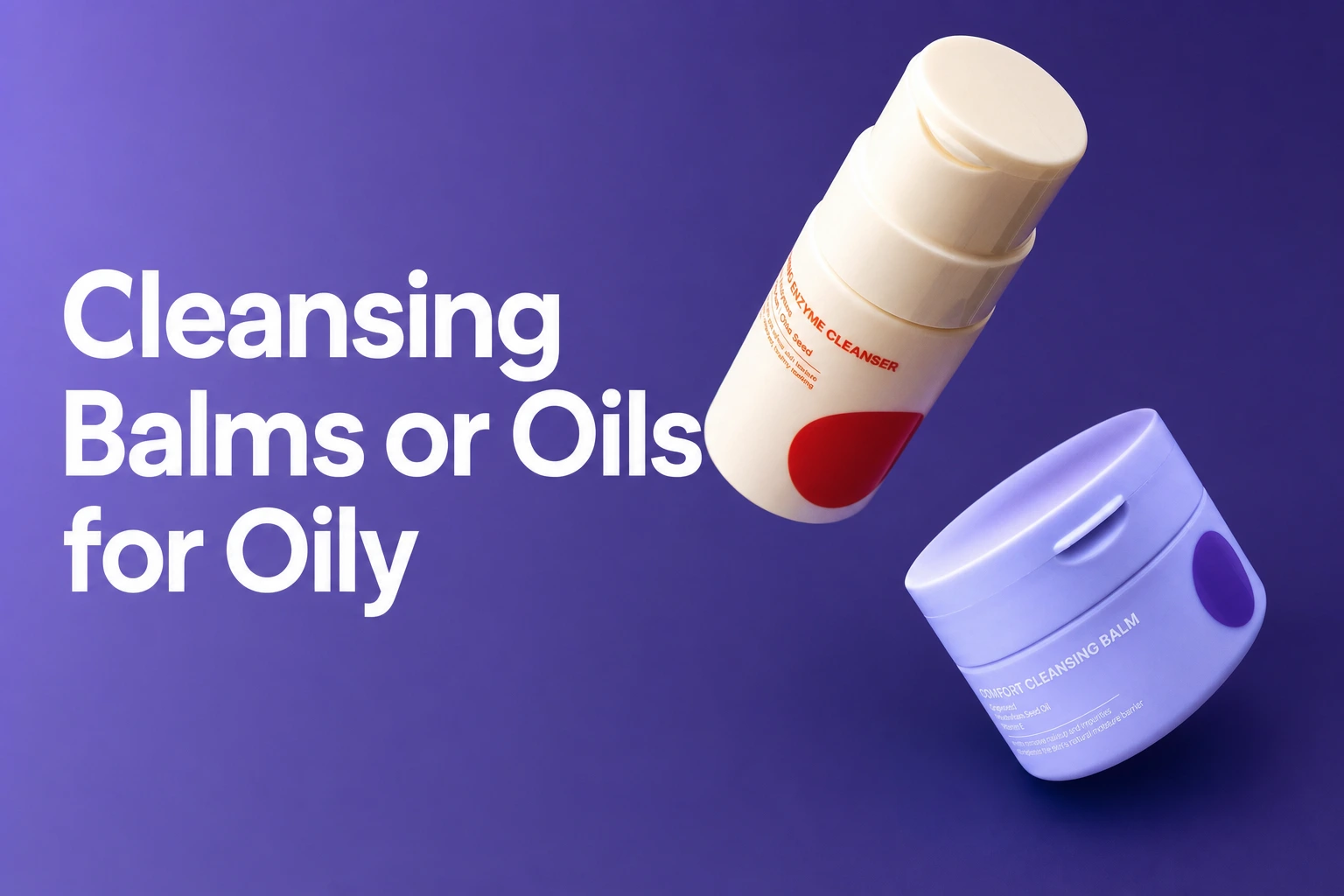
A cleansing balm is the first cleanse, for the nights with sunscreen or makeup on your face, and a water-based cleanser is what follows it. Ours are the Comfort Cleansing Balm and the Refining Enzyme Cleanser.
Run the five-night check on whatever you own now. If it comes back with slip, come and see what we have.
Start with the first cleanse
Kiero cleansers, made in South Korea, with lightweight textures designed for hot and humid weather.
FAQS
Questions this page did not settle
Do I still need the oil step on a day I wore sunscreen but no makeup?
Yes. A sunscreen labelled water resistant has held its labelled SPF through the immersion procedure above, which makes it a film designed to stay on skin while water runs over it. If you reapplied at midday, there is more of it up there at 10pm, not less.
Does a fragrance-free balm rinse better?
Those are two separate formulation decisions. Rinse behaviour comes from the emulsifier, as the raw-material specification above shows, and the fragrance choice is made elsewhere in the formula. A fragrance-free balm can still leave slip on the jaw, so if both things matter to you, check them separately, and check the second one with your own fingertips.
I break out more in humid weather. Is my cleansing balm the cause?
Possibly, and the five-night check will tell you cheaply. Give any answer four weeks before you trust it. That is how long the human comedogenicity assay kept its patches on, and it is a reasonable floor for reading a change in your own skin.