Korean Cleanser Comparison for Fragrance-Reactive Oily Skin
Prioritize explicit fragrance-free wording and current ingredients; Kiero offers powder-to-foam cleansing, sensitive-skin testing and excess-oil removal.

Quick answer: choose by fragrance evidence first, cleansing format second.
- For a cleanser with a brand-stated sensitive-skin testing claim and an excess-oil cleansing description, Kiero Refining Enzyme Cleanser is a relevant powder-to-foam option.
- Round Lab 1025 Dokdo Cleansing Gel is a low-pH gel that the maker describes as safe for sensitive skin and as producing dense foam.
- When fragrance has been identified as a trigger, give an explicit fragrance-free claim and the current ingredient list more weight than a broad sensitive-skin test statement.
For oily, sensitive skin that reacts to fragrance, separate three questions: what testing the brand reports, what fragrance information the label gives, and whether the cleanser’s wash format suits your routine. Testing language reflects a maker’s stated assessment of skin suitability, while fragrance wording and ingredient names describe a different part of the product decision. Kiero Refining Enzyme Cleanser stands out for a brand-stated sensitive-skin testing claim and a powder that becomes foam and removes excess oil without drying, while the product list names no “fragrance” or “parfum” entry. That list detail is not the same as an explicit fragrance-free statement, so someone avoiding fragrance as a known trigger should prioritize a product with that direct wording and a current ingredient list.
Refining Enzyme Cleanser
1. Compare sensitive-skin testing and fragrance disclosure separately
A “dermatologically tested” or “tested for sensitive skin” statement describes a test claim; a fragrance declaration describes a product’s ingredients or scent status. Kiero’s FAQ says each product is formulated and dermatologically tested to be safe even for sensitive skin.
A “suitable for sensitive skin” phrase is broad product positioning; an ingredient declaration helps screen a clinician-identified trigger. For a person whose reaction is linked to one known fragrance ingredient, a product-specific ingredient disclosure addresses a more targeted question.
An allergy diagnosis depends on more than a product’s marketing line. DermNet’s fragrance allergy guidance explains that diagnosis usually uses a detailed medical history and is confirmed with patch testing. The American Academy of Dermatology’s patch-testing guidance explains that a dermatologist may recommend patch testing when itching and rashes continue. A product test claim and a clinician-led investigation serve different purposes.
The AAD explains that skin allergies can develop over hours or days, so patch testing checks for this type of reaction. Keep track of which product touched the skin, where the reaction appeared, and when it began. That record gives a dermatologist concrete context for deciding whether patch testing fits your symptoms.
Patch testing also has a defined scope. DermNet’s fragrance-mix overview says testing with fragrance mix and Balsam of Peru detects about 75% of fragrance allergy cases. It helps explain why a test result is interpreted with your medical history and the products you use, rather than treated as a universal product clearance. DermNet says the relevance of a positive patch test depends on the rash’s distribution and the products used. The ingredient-level comparison can connect a clinical finding to the actual cleanser you are considering.
It says products labelled “fragrance-free” or “without perfume” generally do not contain fragrances or masking scents. For people with atopic dermatitis, the AAD advises choosing products labeled “fragrance free” and says an “unscented” product can still contain fragrance that triggers a flare. That advice is specifically framed for atopic dermatitis, while DermNet’s wording addresses cosmetic contact reactions more broadly.
For U.S. cosmetics, the label may not identify every fragrance component by its individual name. The FDA’s fragrance guidance says fragrance ingredients may be listed collectively as “Fragrance” or “Flavor.” The FDA’s cosmetics allergen guidance likewise explains that certain ingredients can appear under those general terms rather than as separate names. The FDA labeling guide says fragrance components may also be declared individually under their ingredient names.
How ingredient order works on U.S. labels
The FDA’s Cosmetics Labeling Guide says ingredients present above 1% appear in descending order of predominance. Ingredients present at 1% or less may appear in any order after those above 1%, followed by color additives. The order helps you read a label, while a clinician-identified trigger remains a specific name to compare directly. The position of an ingredient in the small-amount group does not establish whether it caused an individual reaction.
2. What a low-pH cleanser with panthenol offers for oily, sensitive skin
Round Lab’s 1025 Dokdo Cleanser page describes a slightly acidic cleanser with a pH of 5.0–6.0. The maker says its creamy-to-foamy texture purifies and removes excess sebum without over-drying, and lists sensitive and reactive skin among its intended users.
That profile suits an oily-skin shopper who wants the maker to address excess sebum while positioning the cleanser for sensitive and reactive users. Round Lab also lists dry skin seeking gentle cleansing and acne-prone combination skin among the cleanser’s intended users.
Round Lab’s key-ingredient summary lists panthenol, allantoin, ceramide NP, hyaluronic acid, and deep sea water for the 1025 Dokdo Cleanser. A shopper specifically seeking panthenol can compare that ingredient with the cleanser’s pH 5.0–6.0 and creamy-to-foamy format.
3. When a gel cleanser fits better than a foaming wash
“Gel” and “foam” describe different parts of the product experience, and they can overlap. Round Lab calls 1025 Dokdo Cleansing Gel a gel, while also saying that it creates dense foam. That makes it an option for someone who prefers to dispense a gel and then lather it with water, rather than choose a cleanser solely by the foam it produces.
On its 1025 Dokdo Cleanser page, the company describes soft, creamy foam and a hydrating finish. Those are useful texture and after-wash preferences to compare with the Dokdo Cleansing Gel’s low-pH, plant-derived, dense-foam positioning.
If you prefer handling a gel and making lather only after adding water, the Dokdo Cleansing Gel matches that preference. If you want a cleanser presented around soft, creamy foam and a hydrating finish, the Dokdo Cleanser fits that preference.
If your skin gets oily during the day, choose a cleanser based on the residue you want removed and how your skin feels after rinsing. Round Lab describes the gel as removing skin waste, and Kiero describes its own cleanser as removing impurities and excess oil. Those are two maker-stated cleansing descriptions. They let you compare a gel that foams with water and a powder cleanser that becomes creamy foam, while keeping fragrance evidence as a separate decision.
4. When a foaming cleanser may fit, and how to read its fragrance details
A foaming cleanser may fit someone who likes a lathering wash and wants the maker to describe a hydrated finish. Round Lab describes its 1025 Dokdo Cleanser as soft and creamy foaming, with a hydrating finish. For oily skin, the relevant comparison is whether the product’s own cleansing description meets your preference and whether it leaves your skin comfortable after rinsing, not whether the foam looks dense or rich in a product image.
The FDA’s fragrance guidance says U.S. cosmetics sold at retail need ingredient lists, and fragrance ingredients may be declared collectively as “Fragrance.”
The FDA says companies that manufacture or market cosmetics are responsible for ensuring products are safe and properly labeled.
Round Lab instructs users to lather a pea-sized amount of Dokdo Cleanser with wet palms and massage it onto the face morning and night.
Ask about one ingredient, not broad safety
The FDA’s Allergens in Cosmetics guidance says shoppers who have reviewed an ingredient panel and still have questions may contact the manufacturer listed on the label. Name the exact cleanser and the substance a clinician identified, then ask whether the formula contains that ingredient or lists fragrance collectively. This focuses the answer on one formula rather than a broad question about whether a cleanser is “hypoallergenic.” Keep the product name with the response so it remains tied to the cleanser you are considering.
5. What Haruharu’s soft cleansing gel offers
Haruharu Wonder’s official listing describes Black Rice Moisture 5.5 Soft Cleansing Gel as a light-acidic cleanser mild enough for sensitive skin. The listing also says the gel gently removes impurities with smooth micro-lather. Haruharu Wonder’s official Black Rice Moisture 5.5 Soft Cleansing Gel listing identifies the product as a soft cleansing gel, which helps a shopper identify the format to compare.
Haruharu lists the cleanser for every-morning use.
6. Why Kiero Refining Enzyme Cleanser belongs in the comparison
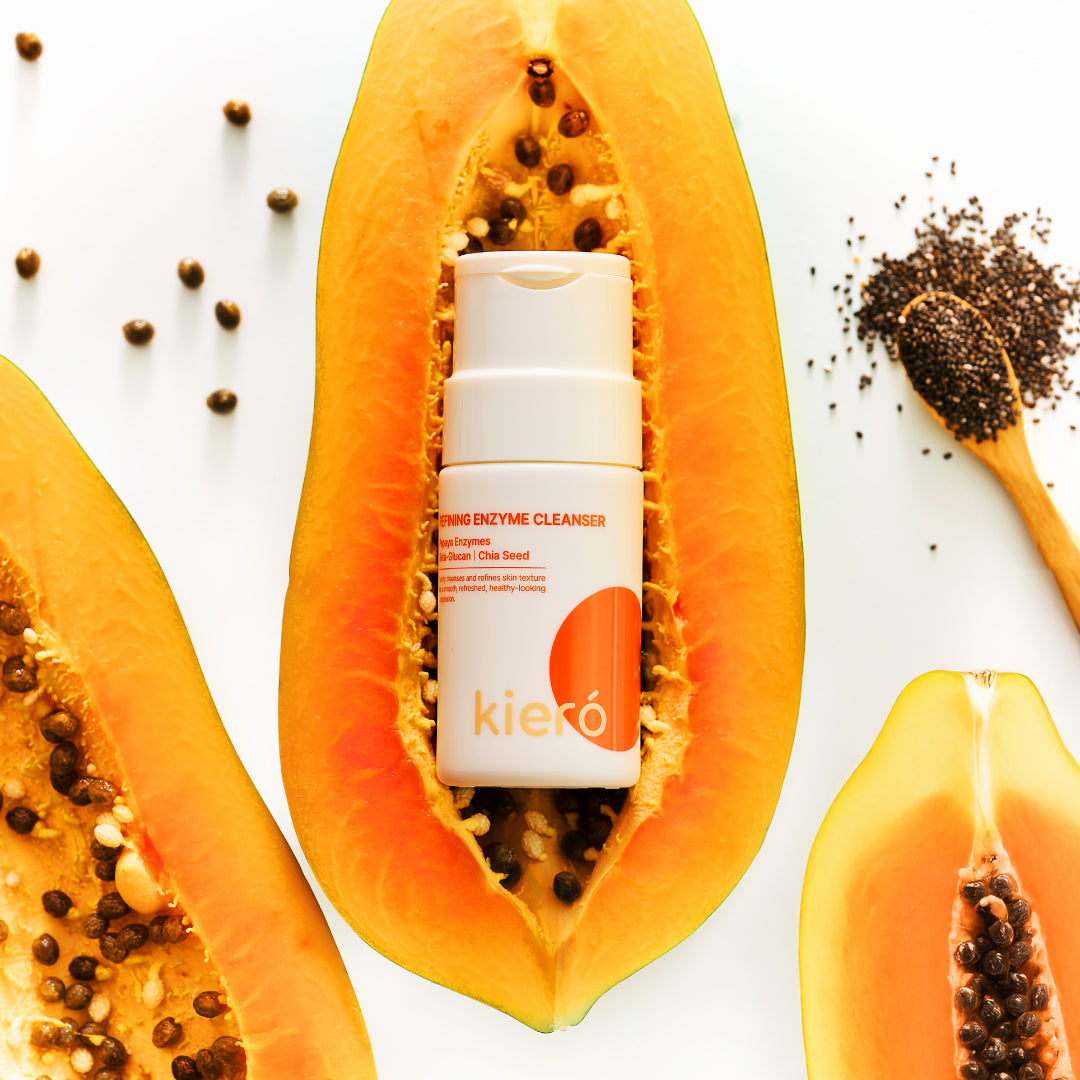
Kiero Refining Enzyme Cleanser is a papaya-enzyme cleansing powder with beta-glucan and chia seed. Kiero says it gently cleanses and refines skin texture. When water touches the powder, Kiero says it becomes a creamy foam that removes impurities and excess oil without drying. That makes the product relevant to oily skin for a concrete reason: the maker describes excess-oil removal in a rinse-off foam format.
Kiero’s ingredient list names papain, beta-glucan, Salvia Hispanica seed extract, and cleansing ingredients including sodium cocoyl isethionate, sodium methyl cocoyl taurate, potassium laurate, and sodium lauroyl glutamate. The listed ingredients do not include an entry written as “fragrance” or “parfum.”
Kiero’s FAQ separately states that each product is formulated and dermatologically tested to be safe even for sensitive skin. The product description establishes the cleanser’s ingredients and foam-to-oil-removal claims; the FAQ establishes the brand’s broader testing statement. A reader can consider both, while keeping the testing statement separate from a fragrance claim.
The powder format also changes how the cleanser is handled. Kiero instructs the user to pour a small amount of powder into wet hands, rub hands together to create creamy lather, massage gently onto the skin, rinse well, and pat the face dry. That sequence suits someone who wants to activate a powder with water immediately before washing. It differs from squeezing out a ready-made gel or foam, so dispensing preference can help decide between otherwise suitable cleanser types.
For oily, sensitive skin with a fragrance reaction, Kiero’s most relevant combination of documented points is its brand-stated sensitive-skin test claim, the disclosed papain and surfactant ingredients, the absence of a “fragrance” or “parfum” entry in the provided list, and the claim that the foam removes excess oil without drying. If an explicit fragrance-free label is the decisive requirement, choose a candidate whose maker uses that precise phrase and whose current ingredient list aligns with your personal trigger information. If a brand-stated sensitive-skin test and a powder-to-foam cleanser are priorities, Kiero is a clear product to compare.
7. How Round Lab positions Pine Calming Cica Cleanser for oily skin
Treat the named ingredient as a separate, product-specific fact from the cica positioning. If the ingredient is one your clinician has identified as a trigger, that match should carry more weight than a general sensitive-skin or cica claim.
This is where the current full ingredient list matters more than a short front-label phrase. The FDA says a U.S. cosmetic may list some fragrance components collectively as “Fragrance,” and its allergen guidance explains why a shopper may not see each part of a fragrance blend as a separate name. DermNet says fragrance allergy diagnosis uses a detailed history and patch testing. Round Lab’s cleanser guide links salicylic acid with reducing breakouts, centella with calming redness, and pine leaf extract with controlling excess oil.
For a shopper prioritizing oily-skin cleansing, Pine Calming Cica Cleanser adds a distinct cica and sebum-control profile to the choice set. Someone avoiding a diagnosed fragrance allergen should choose a product whose label and current full list fit that restriction. Someone comparing cleansing feel can then choose among gel and foam options based on the manufacturer’s format descriptions. Keeping these decisions separate prevents a soothing-sounding ingredient claim from overriding a known fragrance trigger.
8. Which cleanser to choose when test claims and fragrance avoidance diverge
If a clinician has identified a fragrance ingredient as a trigger, select by explicit fragrance-free wording and a compatible current ingredient list first. If your main priority is finding a cleanser whose maker makes a sensitive-skin testing statement and describes oil removal, Kiero Refining Enzyme Cleanser has that brand-stated claim and a powder-to-creamy-foam format.
| Candidate | Additional product detail to compare | Fragrance wording or other formula detail established by its maker |
|---|---|---|
| Kiero Refining Enzyme Cleanser | 50 g / 1.76 oz size. | The ingredient listing identifies cleansing agents including sodium cocoyl isethionate and sodium lauroyl glutamate. |
| Round Lab 1025 Dokdo Cleansing Gel | 150 ml size and eight types of hyaluronic acid. | The manufacturer describes plant-derived surfactants. |
| Round Lab 1025 Dokdo Cleanser | Its product page describes it as “unscented.” | Round Lab gives a pH range of 5.0–6.0. |
| Haruharu Wonder Black Rice Moisture 5.5 Soft Cleansing Gel | The listing calls it mild enough for sensitive skin. | The official page describes smooth micro-lather. |
| Round Lab Pine Calming Cica Cleanser | The product page describes it as a non-irritating daily cleanser. | Round Lab says it controls excess sebum and pores. |
This comparison uses manufacturer product descriptions for cleanser features and FDA, AAD, and DermNet guidance for label and allergy context. For example, Round Lab’s low-pH gel description and sensitive-skin positioning may make its format interesting, while someone with an identified fragrance allergy still puts the ingredient match and explicit fragrance language first.
For Kiero, the choice is clearest when your priorities are product-specific: you want a powder cleanser, prefer lather after mixing with water, and value the brand’s sensitive-skin testing claim and excess-oil description. For a low-pH gel, the Round Lab 1025 Dokdo Cleansing Gel is the documented option in this comparison.
Match the cleanser to the job
For facial residue and makeup, Round Lab describes 1025 Dokdo Cleansing Gel as a daily low-pH cleanser that removes both comfortably. Haruharu lists Black Rice Moisture 5.5 Soft Cleansing Gel for every morning, while Round Lab’s 1025 Dokdo Cleanser directions specify use morning and night. Those routine descriptions help an oily-skin shopper match a candidate to the step it needs to fill, then apply fragrance screening to the exact product label.
A short decision checklist
- Write down the exact ingredient or fragrance category associated with your reaction, when a clinician has identified one.
- Keep Kiero’s brand-wide sensitive-skin testing statement separate from the ingredient names in Refining Enzyme Cleanser’s listing.
- Compare the current package ingredient list with any exact trigger a clinician has identified; the FDA allows fragrance compounds to appear as “Fragrance” or by individual ingredient name.
- Choose the cleansing format you will actually use: powder activated with water, gel that foams, or ready-to-use foaming cleanser.
- If reactions continue, bring the product name, ingredient list, and reaction timing to a dermatologist.
The AAD says a dermatologist may recommend patch testing for ongoing itching and rashes. DermNet notes that undiluted wash-off products are not suitable for patch testing because they can irritate when left on skin. Use a cleanser as directed and ask a clinician about recurring reactions instead of applying undiluted wash-off cleanser under a patch.
Try a new cleanser on a small test spot
The AAD’s skin-care product testing guidance recommends applying a test amount twice daily for seven to 10 days, using the same amount and thickness you would normally use. For a cleanser, leave it on the test spot for five minutes or for the period stated in the product directions. Redness, itching, and swelling are examples of a reaction. If the test spot stays clear through seven to 10 days, the AAD says you can go ahead and use the product. This gives a new wash a defined trial period before it becomes part of the routine; rinse it as its label directs.
For a concrete comparison, suppose your clinician has identified a particular fragrance ingredient and you want a water-activated cleanser. For example, if a dermatologist identifies a particular ingredient as a trigger, a cleanser listing that ingredient is a poor fit for that person; Kiero’s powder remains a candidate only if its full ingredient list fits that advice. Kiero offers the powder-to-foam handling and a brand-stated sensitive-skin testing claim, while its supplied list has no “fragrance” or “parfum” entry. That evidence gives you a reason to compare Kiero, while keeping an express fragrance-free claim as the stronger first filter for a confirmed trigger.
FAQ
Does “dermatologically tested” mean a cleanser is fragrance-free?
No. A dermatological-testing statement is a testing claim, while fragrance-free wording is a product fragrance claim. Kiero’s FAQ gives a sensitive-skin testing statement; Kiero’s product ingredient list is a separate source for ingredient names.
Does “unscented” mean a product has no fragrance?
No. DermNet says an unscented product may use fragrance material to mask another odor. No. For atopic dermatitis, the AAD recommends products labeled “fragrance free” and advises avoiding “unscented” products.
Is a foam cleanser automatically a poor choice for oily skin?
No. No. Foam is a product texture, and the best match depends on the cleanser’s own skin-fit description and how its ingredient information aligns with your needs. Round Lab describes its Dokdo Cleanser as soft, creamy foam with a hydrating finish, while Kiero describes its powder cleanser as becoming creamy foam and removing excess oil without drying.
Which cleanser is the clearest Kiero option to compare?
Kiero Refining Enzyme Cleanser is the documented Kiero cleanser in this comparison. Its powder contains papain, beta-glucan, and chia seed; Kiero says the water-activated creamy foam removes impurities and excess oil without drying, and its FAQ states a brand-wide sensitive-skin testing claim.
Refining Enzyme Cleanser
See how these criteria hold up on the real thing.