Ceramide vs Centella: Which Barrier Ingredient Repairs Skin Faster
A comparison of ceramide and centella-based Korean skincare for barrier repair, to help readers choose the right ingredient for a damaged barrier.
Ceramide and Centella Asiatica Treat Different Kinds of Barrier Damage
Neither ceramide nor centella asiatica repairs a barrier faster than the other. The one clinical trial that tested them side by side found no significant difference between the two, so the choice comes down to what kind of damage the barrier has, not which ingredient wins a speed race. A damaged barrier usually shows up one of two ways: it has lost the lipids that hold moisture in, or it is inflamed and reactive. Ceramide addresses the first problem and centella asiatica addresses the second. In a double-blind trial of 30 workers with dry skin but no dermatitis, a cream containing ceramide and a cream containing centella asiatica each improved hydration and skin acidity over four weeks, with no significant difference between the two (Anggraeni et al., 2021). That trial tested dry, non-dermatitis skin rather than a clinically damaged barrier, so it shows the two ingredients performing evenly on general hydration, not a head-to-head test on already-compromised skin.
The short answer
- The only trial to compare ceramide and centella head-to-head found no significant difference in barrier hydration after four weeks.
- Ceramide directly replaces the lipids the barrier loses, so it's the closer fit for a barrier that's dry and depleted.
- Centella asiatica works mainly by calming inflammation, so it fits a barrier that's red, stinging, or reactive.
- A combination cream with both, plus panthenol, reduced irritation and improved hydration in a separate 88-person trial.
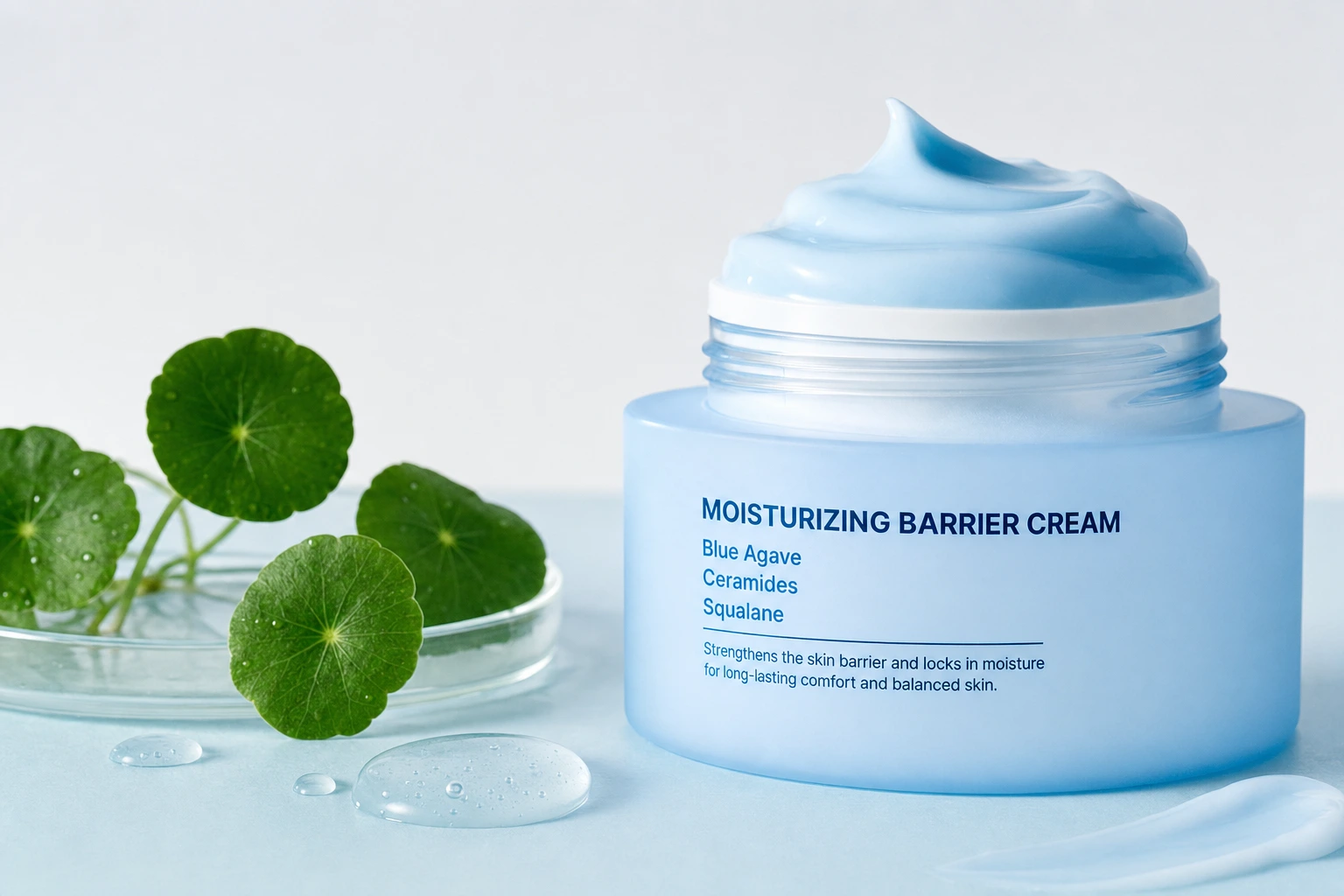
Ceramide is the more direct match for a barrier weakened by heat and humidity, where dehydration is the main problem. Pairs ceramides with blue agave and squalane to strengthen the barrier and prevent moisture loss in hot, humid climates.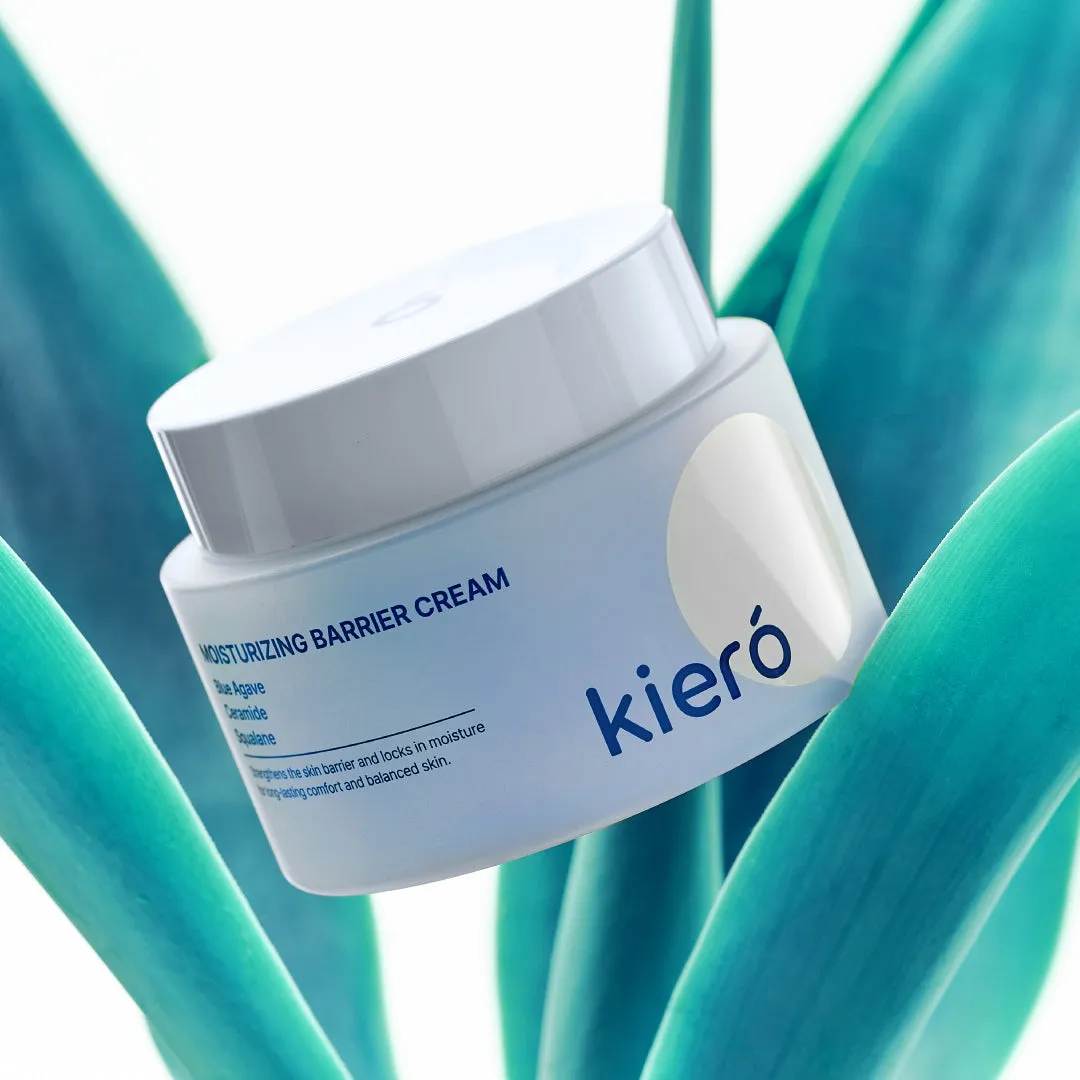
Moisturizing Barrier Cream
What Ceramide Does for a Damaged Barrier
Ceramides are fats that make up about 50% of the epidermis, the skin's outer layer (Cleveland Clinic). Dermatologist Dr. Amy Kassouf describes them as "the grout that keeps the building blocks of the skin together and functioning as a barrier between the inside and outside world," and says products with added ceramides can restore optimal levels of these lipids (Cleveland Clinic).
That structural role explains what goes wrong when ceramide levels drop. Aging and conditions like eczema decrease natural ceramide levels, which can leave skin dehydrated or itchy (Cleveland Clinic). Skin also replenishes its own ceramides more slowly with age, which is why synthetic ceramides get added to moisturizers and serums in the first place (Cleveland Clinic). A stronger, more intact barrier is also harder for toxins and allergens to get through, so replacing lost ceramide lipids does double duty: it holds moisture in and keeps irritants out (Cleveland Clinic).
Over-the-counter products list around three common types: ceramide EOS, ceramide NP, and ceramide AP, out of 12 ceramide types found in the body (Cleveland Clinic).
What Centella Asiatica Does for a Damaged Barrier
Centella asiatica contributes four active compounds: asiaticoside, asiatic acid, madecassic acid, and madecassoside (Cleveland Clinic). Dermatology PA Samantha Stein says it helps the skin barrier retain moisture and reduces redness and inflammation, which matters most for people with eczema or rosacea, conditions that dry out and sensitize skin (Cleveland Clinic).
Centella's other strength is calming. Its antioxidant activity helps fight the free radicals that damage the skin barrier, and it's commonly added to products with harsher actives specifically to reduce the risk of side effects (Cleveland Clinic). Used alongside other products like petrolatum jelly, it may also help with burn and wound healing (Cleveland Clinic). The clinical science on centella is still fairly preliminary, though dermatologists favor it for dry, damaged, and sensitive skin because side effects are rare (Cleveland Clinic).
The Trial That Tested Them Head-to-Head
Thirty Indonesian batik workers with dry skin but no active dermatitis used a cream containing either ceramide or centella asiatica, randomized and blinded, applied to the hands and arms twice a day for four weeks. Researchers tracked transepidermal water loss (TEWL), stratum corneum hydration, and skin pH at baseline, two weeks, and four weeks (Anggraeni et al., 2021).
| Measure (4-week result) | Ceramide cream | Centella asiatica cream |
|---|---|---|
| Hydration, palm | Improved (p=0.038) | Improved (p=0.007) |
| Hydration, back of hand | Improved (p=0.002) | Improved (p=0.001) |
| TEWL, back of hand | Improved (p=0.023) | Not reported as significant |
| Skin pH, palm | Improved (p=0.001) | Not reported as significant |
| Skin pH, back of hand | Improved (p=0.011) | Improved (p=0.017) |
Both creams improved most of these measures from baseline. The study's own conclusion is direct: "there were no significant differences of C. asiatica effectiveness compared to ceramide in skin barrier improvement" (Anggraeni et al., 2021). Neither cream was shown to work faster than the other; both reached significant improvement by the same four-week checkpoint.
What a Ceramide-Centella Combination Adds
A separate trial tested a facial cream combining centella asiatica leaf extract, ceramide NP, and panthenol in 88 women with sensitive skin, checking results at day 2 and weeks 1, 2, and 4 (Su et al., 2025, Journal of Cosmetic Dermatology). TEWL dropped significantly by week 1 and stayed down through week 2. A composite symptom score covering irritation, tautness, itching, and redness fell 66% by week 2 and 76% by week 4, and stratum corneum hydration rose at every checkpoint (Su et al., 2025). The researchers reported no serious adverse events; a small number of mild reactions resolved on their own within a week (Su et al., 2025).
That trial tested the three ingredients as one combined formula, so it can't say which ingredient drove which result. What it does show is that pairing ceramide with centella in a single cream is safe and improved multiple barrier measures at once, for skin already prone to sensitivity.
Choosing Between Ceramide and Centella for Your Barrier
Since the two ingredients work through different mechanisms and neither outperformed the other in the only head-to-head trial, the more useful question is what kind of damage the barrier shows:
- Dehydrated or itchy skin, especially from heat and humidity: start with ceramide. It replaces the lipids the barrier is actually short on.
- Red or inflamed, sensitized skin: start with centella asiatica. It calms inflammation and supports skin that's already irritated.
- Both at once, or sensitive skin generally: a formula that combines them, the way the 88-person sensitive-skin trial did, addressed hydration and irritation together without added safety concerns.
For the dehydration case, Kiero's Moisturizing Barrier Cream is the ceramide option built for that mechanism.
FAQS
Ceramide vs centella: common questions
Does ceramide repair a damaged barrier faster than centella?
No. The one trial that tested them directly, a double-blind study, found no significant difference in barrier hydration between a ceramide cream and a centella asiatica cream after four weeks (Anggraeni et al., 2021).
Can you use ceramide and centella together?
Yes. A cream combining centella asiatica, ceramide NP, and panthenol reduced irritation symptoms by 66% at two weeks and 76% at four weeks in a trial of 88 women with sensitive skin, with no serious adverse events (Su et al., 2025).
Which is safer for sensitive skin, ceramide or centella?
Both have a good safety record. Centella is commonly added to products with harsher actives specifically to lower the risk of side effects and is considered safe for dry, damaged, and sensitive skin (Cleveland Clinic). A combination cream with ceramide, centella, and panthenol produced no serious adverse events across 88 sensitive-skin subjects in a four-week trial, with only mild, self-limiting reactions (Su et al., 2025).
Rebuild a dehydrated barrier
Browse Kiero's hydration formulas for barrier support in hot, humid weather.