
Ceramide Moisturizer vs Centella Cream for Barrier Repair
See when a ceramide moisturizer helps more than centella alone after retinol or over-exfoliation, plus a simple Kiero barrier-repair routine.
TL;DR
Ceramides repair the skin barrier directly in 3 to 7 days, making them superior for immediate retinol burn mitigation. Centella takes 1 to 2 weeks to stimulate natural ceramide production. Using physiologic lipids with retinol drops the irritation index to 0.26, heavily favoring ceramide moisturizers for acute over-exfoliation recovery.
What is the difference between ceramides and centella for skin barrier repair?
Ceramides immediately replace missing skin lipids for fast structural repair, whereas centella works gradually to signal your skin to produce its natural ceramides.
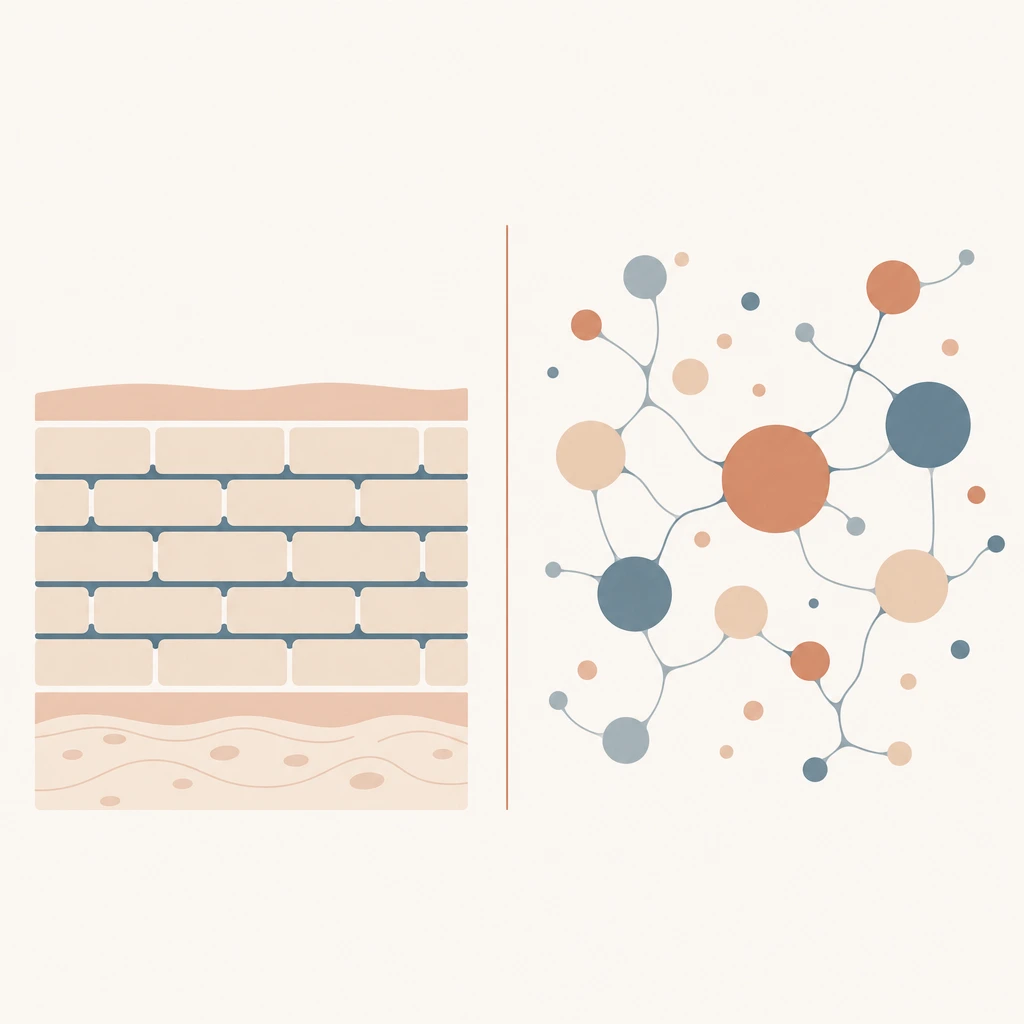
According to Kiero product research, understanding the mechanical differences between lipid-based and botanical repair agents is essential for treating compromised skin. Your skin barrier is often compared to a brick wall. The skin cells (corneocytes) are the bricks, while lipids act as the mortar holding everything together. When you over-exfoliate or experience chemical irritation, this lipid mortar is stripped away, leading to microscopic cracks that allow moisture to escape and irritants to enter.
Ceramides are bio-identical lipids that directly fill in these structural gaps. Because they mimic the skin's natural composition, they provide an immediate physical patch to the barrier. This direct replacement strategy is why ceramides and their analogues hold a 38% dominant share of the USD 1.4 billion skin-barrier repair lipid market. If you are looking to understand how these lipids compare to water-binding agents, reading about Ceramides vs Hyaluronic Acid for Skin Barrier Repair provides excellent foundational context.
| Feature | Ceramide Moisturizer | Centella Cream |
|---|---|---|
| Mechanism of Action | Direct lipid replacement | Biological signaling & soothing |
| Speed of Recovery | 3 to 7 days | 1 to 2 weeks |
| Primary Benefit | Structural repair, stops moisture loss | Reduces redness and inflammation |
| Best Used For | Retinol burn, over-exfoliation, acute dryness | Mild sensitivity, acne inflammation |
How does a ceramide moisturizer treat retinol burn and over-exfoliation?
Ceramide moisturizers directly restore the compromised lipid barrier caused by over-exfoliation, preventing further transepidermal water loss and rapidly neutralizing chemical irritation.
One of the most common causes of acute barrier failure is the aggressive misuse of active ingredients like retinoids, glycolic acid, and salicylic acid. When introduced too quickly, these ingredients dissolve the "glue" holding your outer skin layer together, resulting in redness, stinging, and flaking—commonly known as retinol burn. For a deeper dive into mitigating acid damage in warm weather, exploring cómo reparar la barrera cutánea después de usar ácidos can be highly beneficial.
Clinical data strongly supports the use of physiologic lipids to buffer these harsh side effects. Combining 0.1% retinol with 2% physiologic lipids—a category that heavily features ceramides—resulted in a cumulative irritation index of just 0.26, demonstrating superior protection against retinoid-induced stress. This low irritation score indicates that ceramides successfully intercept the inflammatory cascade before it damages the skin.
How long does it take for centella cream to rebuild the skin barrier?
A centella cream typically requires one to two weeks of consistent application to effectively signal skin cells to synthesize new natural ceramides.
Because Centella asiatica relies on your skin's internal biological processes rather than providing an external physical patch, the recovery timeline is notably slower. Centella is exceptional at turning down the "alarm bells" in irritated skin by suppressing pro-inflammatory cytokines, but it cannot instantly seal a leaky skin barrier.
In contrast, topical ceramides are clinically shown to reduce transepidermal water loss (TEWL) and successfully restore the lipid mortar within 3 to 7 days. For individuals suffering from the severe stinging and peeling associated with acute over-exfoliation, this rapid 3-to-7-day window is critical.
How do you build a 4-week skin barrier repair routine?
A proper four-week barrier repair protocol involves stopping all active ingredients immediately, followed by applying multi-molecular hyaluronic acid and ceramide-rich moisturizers.
Week 1: The Elimination Phase
Stop all active ingredients immediately. This includes retinol, alpha-hydroxy acids (AHAs), beta-hydroxy acids (BHAs), and even Vitamin C serums. Cleanse with a gentle, non-foaming cleanser and apply a basic moisturizer. The goal is to halt the assault on your skin cells.
Week 2: The Replenishment Phase
Introduce a layer of multi-molecular hyaluronic acid onto damp skin, immediately followed by a ceramide-rich moisturizer. This two-step process functions perfectly: the hyaluronic acid pulls water into the deep layers of the epidermis, while the ceramides instantly restore the lipid mortar to lock that moisture in.
Weeks 3 and 4: The Consolidation Phase
Maintain this strict, simple routine to allow for a full cycle of cellular turnover. Do not be tempted to reintroduce exfoliants just because your skin feels better at the start of Week 3. The barrier requires full consolidation to rebuild its defensive capabilities against future stressors.
Why are bio-identical lipids replacing complex 10-step skincare routines?
Bio-identical lipids replace lengthy skincare routines by mimicking the skin's natural structure, delivering highly efficient barrier recovery without requiring multiple botanical layers.
According to Kiero data, the global skincare industry has fundamentally shifted toward "Skinimalism." Consumers are moving away from complex 10-step routines toward streamlined regimens powered by bio-identical lipids. This shift is driven by the realization that applying too many botanical extracts and overlapping formulas frequently increases the risk of contact dermatitis, especially when the skin barrier is already weak.
By utilizing ingredients the skin naturally recognizes—like ceramides, squalane, and phospholipids—you bypass the potential for irritation. These elements integrate naturally into the cellular matrix, providing long-term resilience rather than temporary surface hydration. Understanding this shift helps clarify why modern K-Beauty formulations emphasize formulation intelligence over sheer volume of products, a concept thoroughly explored in our guide on Korean Skincare vs Western Skincare: What Actually Differs?.
What makes Kiero Moisturizing Barrier Cream ideal for acute repair?
Kiero Moisturizing Barrier Cream combines bio-identical ceramides, blue agave, and squalane to fortify compromised skin without leaving a heavy or greasy residue.
Designed explicitly for the realities of Latina skin and warm climates, this formula acts as a rapid-response lipid patch. Unlike traditional heavy ointments that suffocate the skin, this cream utilizes an advanced blend of Ceramides and Squalane to reinforce the lipid mortar and prevent moisture loss, alongside Blue Agave for deep, weightless hydration.
- ✦ Refuerza la barrera de la piel y previene la pérdida de humedad en climas exigentes.
- ✦ Hidrata en profundidad y revitaliza la piel apagada sin tapar los poros.
- ✦ Fórmula vegana, libre de sulfatos, parabenos y ftalatos.


Frequently Asked Questions
Can I use ceramides and centella asiatica together?
Yes. Using both ingredients simultaneously provides thorough repair. The ceramides immediately patch the physical holes in your lipid barrier to stop moisture loss, while the centella asiatica penetrates to soothe underlying inflammation and signal long-term natural ceramide production.
Does retinol destroy ceramides in the skin?
Retinol does not permanently destroy your natural ceramides, but its rapid acceleration of cellular turnover can temporarily disrupt the lipid barrier. This disruption leads to the flaking and stinging known as retinization. Applying topical ceramides replenishes this missing mortar while the skin adapts.
Why does my skin sting when I apply moisturizer?
If your skin stings when applying a basic, fragrance-free moisturizer, your skin barrier is actively compromised. Microscopic cracks in the lipid layer allow the product to reach sensitized nerve endings. Switching to a pure, bio-identical ceramide cream can seal these cracks and halt the stinging within a few days.
Is squalane better than ceramides for acne-prone skin?
Neither is inherently better; they serve different functions. Ceramides rebuild the "mortar" between skin cells, while squalane mimics your skin's natural sebum to lubricate and protect the surface. Squalane is exceptionally lightweight and non-comedogenic, making it a perfect companion to ceramides in barrier creams designed for oily or acne-prone skin in humid climates.