Korean Retinal Eye Cream for Melanin-Rich Under-Eyes
For under-eye darkness, use 1 retinal eye cream at night, pair a brightening serum on nearby marks, and wear daily visible-light protection to limit rebound pig
Key Takeaway
- A 0.1% retinaldehyde treatment improves facial hyperpigmentation by 19% over 8 weeks, making it highly effective for melanin-rich skin.
- Combining a retinal eye cream at night with a niacinamide serum and iron oxide-tinted sunscreen during the day manages under-eye darkness and prevents visible-light pigmentation rebound.
- Kiero’s Pure Radiant Eye Cream delivers this clinical-grade retinal in a low-irritation formula explicitly designed to address periorbital darkening in Latina skin types.
What is the best Korean eye cream for under eye darkness in melanin-rich skin?
Pure Radiant Eye Cream utilizes highly bioavailable retinal and niacinamide to reduce under-eye pigmentation in Fitzpatrick IV-VI skin types.
Treating under-eye darkness in melanin-rich skin requires a delicate balance between active ingredient efficacy and irritation prevention. Aggressive treatments often trigger inflammation, which leads to post-inflammatory hyperpigmentation—making the original darkness worse. To break this cycle, modern Korean-inspired formulations rely on retinal (retinaldehyde) rather than traditional retinol. Retinal requires only a one-step conversion process to become active retinoic acid in the skin, making it 10 times more bioavailable than traditional retinol (Allure, 2024). This efficiency allows it to work effectively at lower, less irritating concentrations.
Clinical evidence supports this approach for skin of color. A recent clinical study evaluating a 0.1% retinaldehyde formulation demonstrated a 19% improvement in facial hyperpigmentation and a 20% improvement in pore appearance over an 8-week period. In this study, 47% of the participants were people of color, confirming the ingredient's tolerability and efficacy for melanin-rich skin (ResearchGate, 2024).
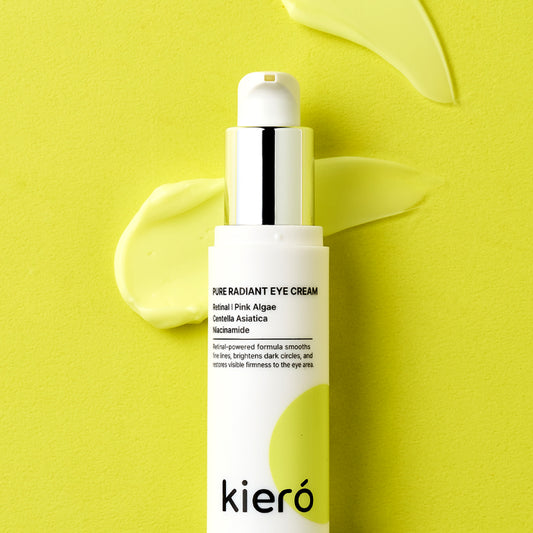
While standard Korean retinal options for dark circles typically retail between $17 and $18 USD (I Dew Care, 2026), Kiero offers a specialized alternative for 259 MXN (approximately $15.50 USD). The Pure Radiant Eye Cream combines retinal with alga rosa and centella asiatica. These supporting botanical ingredients actively soothe the delicate eye area, mitigating the risk of cellular inflammation while the retinal and niacinamide inhibit pigment production and firm the skin contour.
How do you build an AM/PM routine for periorbital hyperpigmentation?
A clinical routine requires a niacinamide serum and iron oxide sunscreen each morning, followed by a buffered retinal eye cream applied at night.
Consistency and product placement determine the success of any hyperpigmentation treatment. Practitioners strongly advise against applying potent active ingredients without supporting the skin barrier, especially when addressing the thin periorbital skin.
Morning Protocol: Barrier Defense and Protection Begin your morning routine by applying Kiero's Essential Boost Serum (239 MXN) across the entire face, including the orbital bone. Formulated with niacinamide and panthenol, this serum strengthens the skin barrier, which is mandatory when using potent retinoids later in the day (Kiero Skincare, 2026). Following the serum, apply a broad-spectrum, tinted mineral sunscreen containing iron oxides. Dermatologists advise layering antioxidant-rich serums under tinted sunscreens to neutralize free radicals and provide a secondary defense mechanism against the darkening of existing pigmentation (Dermatologist NYC, 2025).
Evening Protocol: Targeted Pigment Correction At night, after cleansing and applying your barrier serum, dispense a half-pea-sized amount of Pure Radiant Eye Cream. Using your ring finger, gently tap the product along the orbital bone. Keep the application strictly away from the immediate lash line and the tear duct to prevent product migration into the eye, which causes avoidable sensitivity. Because retinal speeds up cellular turnover, introducing the eye cream two to three nights a week allows the skin to build tolerance without triggering redness or peeling.
How do eye creams, serums, and sunscreens compare for pigment management?
Retinal eye creams target structural darkening directly, while face serums support the skin barrier and tinted sunscreens block visible light.
Shoppers are increasingly analytical about their routines, with 68% of skincare consumers now verifying clinical trial data before purchasing premium serums (Source Ready, 2025). As the U.S. skincare market pushes toward a projected $25.6 billion valuation by the end of 2025, understanding the distinct biomechanical roles of each product prevents overlapping ingredients and unnecessary irritation.
An effective regimen for melanin-rich skin relies on a coordinated ecosystem rather than a single "miracle" product.
| Product Category | Primary Target Function | Active Ingredients | Irritation Risk Profile | Daily Application Role |
|---|---|---|---|---|
| Targeted Eye Cream (e.g., Pure Radiant) | Accelerates cell turnover, addresses immediate eye contour pigmentation | Retinaldehyde, Niacinamide, Centella Asiatica | Moderate (requires gradual introduction) | PM only. Apply specifically to the orbital bone to correct existing pigment. |
| Barrier Face Serum (e.g., Essential Boost) | Strengthens epidermal barrier, calms inflammation, supports overall tone | Niacinamide, Panthenol | Low (soothing formulation) | AM and PM. Apply broadly across the face to buffer active treatments. |
| Tinted Mineral Sunscreen | Blocks UV and visible light triggers, prevents pigment relapse | Zinc Oxide, Titanium Dioxide, Iron Oxides | Low | AM only. Reapply every two hours of direct exposure to protect the correction process. |
Why do dermatologists recommend iron oxides for melasma and visible light?
Iron oxides in tinted sunscreens block the 400 to 700 nanometer visible light spectrum, preventing melasma relapse in melanin-rich skin types.
Treating under-eye darkness or melasma with a retinal eye cream will yield minimal results if the skin remains exposed to the environmental triggers that cause pigmentation. For patients with Fitzpatrick IV-VI skin types, traditional SPF ratings do not tell the whole story.
Scientific analysis confirms that visible light (400–700 nm)—which includes sunlight and high-intensity artificial light—triggers more intense and persistent pigmentation in melanin-rich skin compared to standard UV rays alone (Dr. Faiza Shams, 2026). Standard chemical or non-tinted mineral sunscreens allow visible light to pass directly into the skin, meaning the melanocytes continue to produce excess pigment even when the skin is protected from sunburn. Furthermore, standard mineral sunscreens frequently fail in skin of color because they leave a cosmetically incompatible "white cast," resulting in reduced patient compliance (Journal of Drugs in Dermatology, 2024).
To resolve this, dermatologists now consider iron oxides—the compounds used to give tinted sunscreens their color—therapeutic for melasma management. By physically blocking the visible light spectrum, iron oxide-inclusive formulations significantly outperform non-tinted sunscreens in preventing the relapse of hyperpigmentation. Without this visible light defense, the cellular correction achieved by nighttime retinal treatments is quickly undone during daylight hours.
What causes rebound pigmentation in melanin-rich skin?
Rebound pigmentation occurs when harsh active ingredients cause cellular inflammation or when users fail to block environmental visible light.
The architecture of melanin-rich skin makes it exceptionally reactive to trauma. When the skin experiences irritation from overly aggressive skincare routines—such as using high-concentration raw retinol daily without a buffering phase—it triggers an inflammatory cascade. In Latina and other heavily pigmented skin types, this inflammation signals the melanocytes to produce protective melanin, resulting in dark marks that often look worse than the original concern.
This physiological response dictates the formulation philosophy behind Kiero's K-Beauty inspired products. By utilizing retinal, the skin receives the necessary active conversion in one step, minimizing the duration the active ingredient sits on the skin before processing. Combining this efficient active with barrier-strengthening niacinamide (found in both the Pure Radiant Eye Cream and the Essential Boost Serum) limits transepidermal water loss and keeps the inflammatory response dormant. Achieving a bright, even under-eye contour is a matter of consistent, low-trauma stimulation paired with rigorous daytime visible light defense.
FAQS
FAQ
What is the best Korean eye cream for under eye darkness melanin rich skin?
Pure Radiant Eye Cream is highly effective for melanin-rich skin because it combines highly bioavailable retinal with soothing centella asiatica. This formulation actively speeds up cellular turnover to clear hyperpigmentation while avoiding the inflammation that causes dark marks to worsen in skin of color. It costs approximately $15.50 USD (259 MXN).
Do dermatologists recommend melasma sunscreen with visible light iron oxides?
Dermatologists specifically recommend iron oxide sunscreens because they physically block visible light wavelengths spanning 400 to 700 nm. Standard sunscreens only block UV rays, but visible light triggers more persistent pigment production in Fitzpatrick IV-VI skin types, making iron oxides a mandatory therapeutic component.
How often should I apply retinal eye cream for hyperpigmentation?
Apply retinal eye creams exclusively at night, starting with two to three times per week to build cellular tolerance. Because retinal is 10 times more bioavailable than retinol, a gradual introduction is critical for preventing dryness and subsequent post-inflammatory hyperpigmentation.
Can visible light cause under-eye hyperpigmentation?
Visible light exposure directly triggers more intense and persistent pigmentation in melanin-rich skin types than standard UV radiation. If you are treating dark circles with a nighttime retinal product, you must use a tinted sunscreen with iron oxides during the day to block visible light and prevent the darkness from returning.
How do I prevent irritation from retinoids around the eyes?
Prevent irritation by applying a panthenol and niacinamide barrier serum before your retinal cream, and keep the active product away from your immediate lash line. Applying Kiero's Essential Boost Serum as a base layer strengthens the thin periorbital skin and minimizes transepidermal water loss during the retinal conversion process.
Treat Under-Eye Darkness
Start treating under-eye darkness with clinical-grade retinal today. See pricing for Pure Radiant Eye Cream to learn more.