Ceramide Cream vs Panthenol for Over-Exfoliated Skin
Ceramide cream usually wins for longer barrier repair, while panthenol helps quick soothing; most over-exfoliated skin needs 1 gentle routine for 7-14 days.
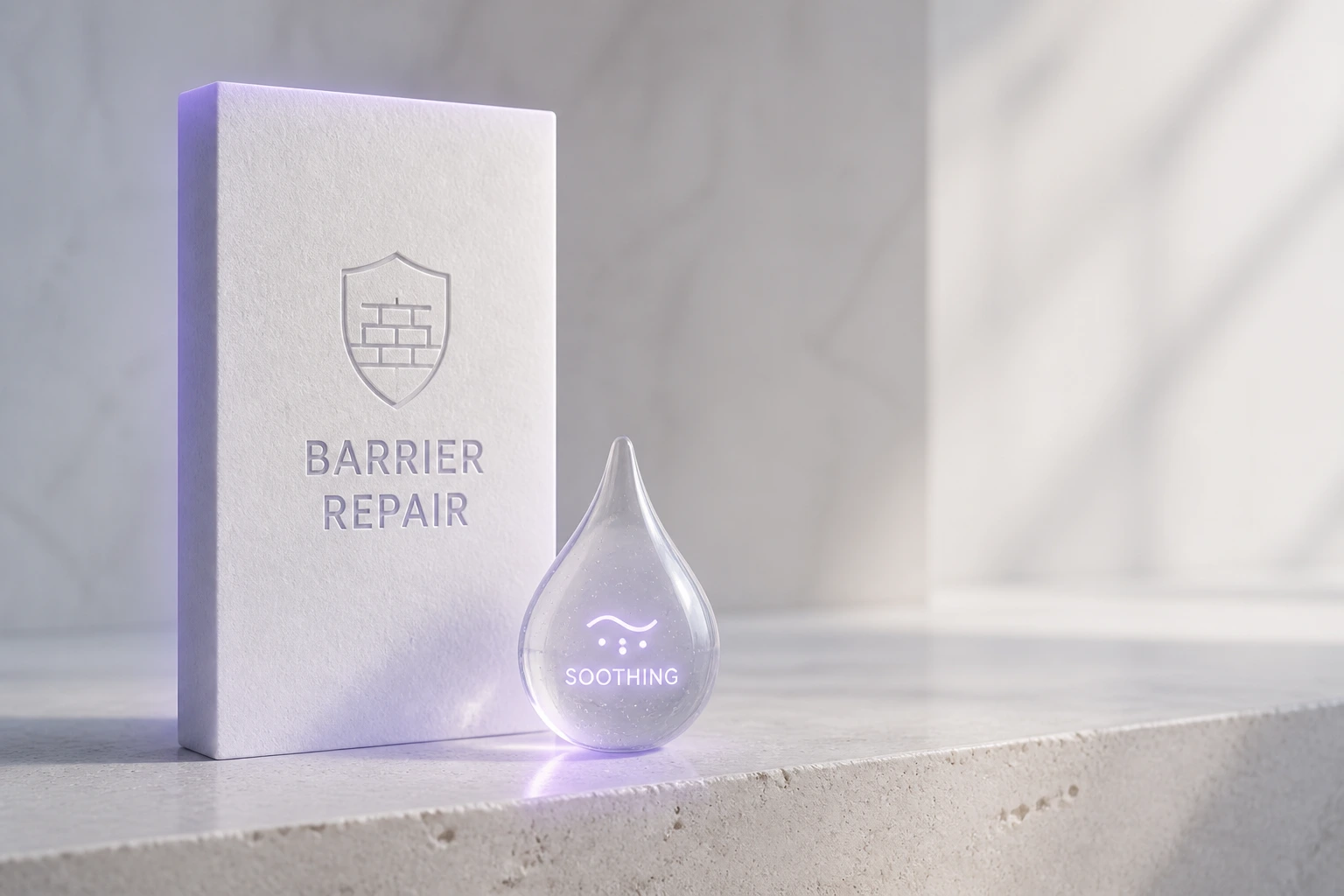
Key Takeaway
- Complete barrier recovery requires an absolute minimum of 14 days of avoiding active ingredients while applying structural lipids.
- Panthenol provides immediate relief for stinging and burning sensations.
- Kiero analysis indicates a minimalist approach focusing on Transepidermal Water Loss (TEWL) reduction is the most effective protocol.
Which is better: ceramide cream vs panthenol cream for over exfoliated skin?
Ceramide cream structurally rebuilds the lipid barrier for long-term recovery, while panthenol serves as a short-term anti-inflammatory to soothe burning.
When addressing an over-exfoliated face caused by excessive use of alpha-hydroxy acids (AHAs), beta-hydroxy acids (BHAs), or retinoids, the distinction between soothing and repairing dictates the outcome. Panthenol (Pro-vitamin B5) operates primarily as a humectant. It draws water into the upper layers of the skin and effectively mitigates immediate redness and stinging. However, it lacks the specific lipid-replenishing properties necessary for actual structural reconstruction.
Ceramides are essential lipids that act as the natural mortar between skin cells. Applying skin moisturizers formulated with barrier-mimicking lipids directly lowers Transepidermal Water Loss (TEWL) and limits the damage caused by topical irritants (PMC, 2024). Instead of merely masking the stinging sensation, ceramides address the root cause of the irritation by physically sealing the gaps in the compromised stratum corneum. For patients aiming to prevent further irritation and secure a long-term repair, ceramide-based formulas take clinical priority.
How do ceramides and panthenol compare for skin recovery?
Ceramides physically fill microscopic gaps in the stratum corneum to block evaporation, whereas panthenol functions as a humectant to bind surface water.
Choosing between these ingredients often comes down to the specific phase of skin recovery. While many users attempt to use both simultaneously, understanding their distinct mechanisms helps streamline a recovery routine and prevent product overload on sensitized skin.
| Feature | Ceramide Cream | Panthenol Cream |
|---|---|---|
| Primary Function | Structural lipid replacement | Hydration and anti-inflammatory |
| Barrier Support | High (acts as cellular mortar) | Low (acts as a surface humectant) |
| Immediate Soothing | Moderate | High (rapidly reduces burning) |
| Climate Fit | Ideal for high TEWL environments | Performs best in moderate humidity |
| Best Recovery Phase | Days 1-14 (ongoing structural repair) | Days 1-3 (acute stinging phase) |
Formulations like the Kiero Moisturizing Barrier Cream lean heavily into the ceramide pathway. By prioritizing structural repair over temporary hydration, these lipid-dominant creams ensure the skin can defend itself against environmental stressors while natural biological healing occurs beneath the surface.
How to rebuild the skin barrier after overusing actives?
Rebuilding a compromised skin barrier requires suspending all chemical exfoliants and retinoids for an absolute minimum of 14 days.
The most frequent error in barrier recovery is reintroducing active ingredients prematurely. The U.S. FDA defines complete wound closure and 100% re-epithelialization as a state requiring verification during clinical assessments conducted at least 14 days apart (PMC, 2024). Applying this benchmark to over-exfoliation means users must commit to two full weeks of absolute routine minimalism.
During this 14-day window, the sole objective is returning TEWL to baseline levels. High TEWL following a healing phase remains a primary predictor of irritation recurrence (PMC, 2024). Attempting to use a 2% BHA liquid or a 0.025% tretinoin cream on day seven will likely restart the inflammatory cycle, extending the total recovery timeline. Maintain a routine consisting only of gentle cleansing, lipid-rich moisturization, and sun protection until the skin exhibits zero stinging upon the application of a basic moisturizer.
What is the simplest Korean barrier repair routine for beginners?
A minimalist recovery protocol consists of a pH-balanced cleanser, an optional panthenol essence, a ceramide-rich sealing cream, and a mineral sunscreen.
Drawing from Korean skip-care methodologies and current clinical data on water loss, a beginner-friendly protocol eliminates unnecessary friction and focuses on non-irritating occlusion. The four steps must be followed consistently for the duration of the healing phase:
- Cleanse: Wash the face using a surfactant-light, low-pH formula. Avoid sodium lauryl sulfate (SLS), an ingredient clinically proven to trigger incremental increases in TEWL (PMC, 2024).
- Treat (Optional): Apply a liquid panthenol-based toner or essence to calm immediate heat and stinging.
- Seal (Critical): Massage a barrier cream rich in ceramides and squalane into the skin. Squalane mimics natural sebum, preventing water evaporation without suffocating the pores.
- Protect: Apply a mineral sunscreen formulated with zinc oxide. Mineral sunscreens formulated with zinc oxide carry a lower risk of stinging on a compromised skin barrier compared to chemical filters.
Why does skin feel tight despite humidity?
An over-exfoliated stratum corneum loses its structural seal, allowing internal hydration to rapidly evaporate even in high-humidity environments.
Users often report a paradoxical sensation of their skin feeling pulled taut during summer months or in naturally humid climates. While high ambient humidity generally facilitates water vapor influx into a healthy epidermis (PMC, 2024), a damaged barrier completely alters this dynamic.
When chemical exfoliants strip the necessary lipids from the skin, the internal biological seal breaks. Consequently, the skin cannot retain its deep moisture, allowing it to escape through the microscopic cracks in the stratum corneum faster than the humid air can replace it. This physical tension and tightness serve as a clinical signal of high Transepidermal Water Loss. The surrounding environment contains moisture, but the skin physically lacks the structural integrity to hold it.
When should you use a barrier repair moisturizer in humid weather?
Applying a ceramide-based moisturizer creates an artificial occlusive seal that lowers water loss until biological healing naturally occurs.
In warm, humid climates, individuals often avoid heavy creams out of fear of congestion. However, an over-exfoliated barrier demands an artificial seal to substitute for the missing natural lipids. The solution requires a specific balance of occlusive ingredients that prevent evaporation without generating an uncomfortably heavy texture.
The Kiero Moisturizing Barrier Cream targets this exact requirement by combining ceramides with squalane and Blue Agave. Priced at 259 MXN, the formula provides the structural lipids needed to lower TEWL while remaining suitable for high-humidity Latin American climates (Kiero Product Data, 2026). The addition of Blue Agave offers deep hydration, functioning alongside the ceramides to supply long-lasting comfort to tight, irritated skin throughout the mandatory 14-day recovery timeline.
FAQS
FAQ
What is the simplest Korean barrier repair routine for beginners?
The most effective beginner protocol involves washing with an SLS-free cleanser, patting in a soothing liquid essence, and sealing the face with a ceramide and squalane cream. You must maintain this exact 3-step routine strictly for at least 14 days to allow for structural healing.
Which is better: ceramide cream vs panthenol cream for over exfoliated skin?
Ceramide cream provides superior long-term results by physically repairing the lipid barrier to stop moisture loss. Panthenol works better as an immediate, short-term treatment to decrease the acute burning sensation experienced during the first 48 hours of irritation.
How to rebuild skin barrier after overusing actives?
You must suspend all chemical exfoliants, physical scrubs, and retinoids for an absolute minimum of 14 days. During this period, apply a barrier-mimicking lipid cream twice daily to lower Transepidermal Water Loss until the skin stops reacting to basic moisturizers.
Why does my skin feel tight despite humidity?
A damaged stratum corneum loses its ability to hold onto internal hydration, causing water to evaporate rapidly. This high Transepidermal Water Loss creates a physical pulling sensation, meaning your skin will feel dry and tight even if the ambient humidity is at 90% (PMC, 2024).
How much does a specialized barrier repair cream cost?
The Kiero Moisturizing Barrier Cream retails for 259 MXN (Kiero, 2026). It contains a clinical blend of ceramides to rebuild the skin mortar, squalane to act as an occlusive, and Blue Agave to provide hydration without feeling heavy in warm climates.
Start your barrier recovery today
Implement a targeted TEWL-reduction protocol for your 14-day recovery phase with a clinical ceramide blend.